Freshdesk vs Help Scout vs Intercom
Freshdesk and Help Scout are both traditional, email- and ticket-centric helpdesks at accessible per-seat prices, while Intercom is built AI-first around Fin,…
Freemium · From Free (limited-time program for up to 2 agents); paid plans start at $19/agent/month billed annually
Best for: Teams that want an affordable, broad-channel helpdesk with field service dispatch included alongside standard ticketing.
Freemium · From Free (paid plans from $25/user/month)
Best for: Small teams and startups that want the simplest, most affordable, email-native support tool with a genuine free plan.
Subscription (per-seat plus AI usage-based) · From $29/seat/month (billed annually)
Best for: Mid-market and enterprise teams that want an AI-first support stack where Fin autonomously resolves a large share of routine tickets.
At a Glance
| Freshdesk | Help Scout | Intercom | |
|---|---|---|---|
| Primary category | Help Desk | Help Desk | Help Desk |
| Rating | Not documented | Not documented | Not documented |
| Pricing model | Freemium | Freemium | Subscription (per-seat plus AI usage-based) |
| Starting price | Free (limited-time program for up to 2 agents); paid plans start at $19/agent/month billed annually | Free (paid plans from $25/user/month) | $29/seat/month (billed annually) |
| Free plan | Yes | Yes | Not documented |
| Free trial | Yes | Yes | Yes |
| Platforms | Web, iOS, Android | Web | Web, iOS, Android |
| Team collaboration | Not documented | Not documented | Not documented |
| AI features | Yes | Yes | Yes |
| Public API | Yes | Yes | Yes |
Standout Differences
Intercom is built around an autonomous AI resolution agent
Fin reads a company's help center and support history to resolve customer questions across chat, email, and voice on its own, escalating to humans only when needed, and is billed at $0.99 per successful resolution rather than bundled into seat pricing.
Intercom
Help Scout is the only one with a permanent free plan
Help Scout's free plan supports up to 5 users, 1 inbox, and 1 Docs site at no cost, while Freshdesk's free option is a time-limited 6-month program and Intercom has no free tier.
Help Scout
Freshdesk adds field service management and undercuts Intercom on entry price
Freshdesk's Growth plan starts at $19 per agent per month, below Intercom's $29 per seat Essential plan, and Freshdesk is the only one of the three offering field service scheduling and dispatch for on-site technicians.
Freshdesk
AI costs stack very differently across the three
Freshdesk's Freddy AI Copilot is a flat per-agent add-on, Help Scout's AI Answers charges per resolution on top of a base subscription, and Intercom's Fin is priced per resolution as a core part of the product rather than an optional extra.
Freshdesk, Help Scout, Intercom
Feature-by-Feature
Core Inbox and Ticketing
| Feature | Freshdesk | Help Scout | Intercom |
|---|---|---|---|
| Shared or collaborative inbox | Available | Available | Available |
| Self-service knowledge base or help center | Available | Available | Available |
AI and Automation
| Feature | Freshdesk | Help Scout | Intercom |
|---|---|---|---|
| AI-assisted reply drafting for human agents | Available | Available | Available |
| Autonomous AI ticket resolution | Limited | Limited | Available |
Channels and Engagement
| Feature | Freshdesk | Help Scout | Intercom |
|---|---|---|---|
| Omnichannel messaging (chat, email, voice, WhatsApp) | Available | Available | Available |
| Proactive outbound messaging (banners, tours, campaigns) | Not documented | Not documented | Available |
Plans and Cost Structure
| Feature | Freshdesk | Help Scout | Intercom |
|---|---|---|---|
| Permanent free-forever plan | Unavailable | Available | Unavailable |
| Field service management | Available | Unavailable | Unavailable |
Pricing Compared
Starting price reflects the lowest paid tier, not the full cost for every team size or usage level.
Freshdesk
Help Scout
Intercom
Pros & Cons
Freshdesk
Pros
- Lower entry price than Zendesk with a comparable core feature set
- Fast to set up and learn, with an intuitive agent interface
- Strong automation and self-service tools even on mid-tier plans
- Broad channel coverage (email, chat, phone, social, WhatsApp)
Cons
- Permanent free plan was discontinued in 2025, replaced with a time-limited free program
- Freddy AI Copilot is a separate paid add-on rather than bundled in lower tiers
- Enterprise-grade features (sandboxing, advanced security, audit logs) require the top tier
- Per-agent pricing can get expensive quickly for larger support teams
Help Scout
Pros
- Free plan and low per-seat pricing make it accessible to very small teams
- Inbox-style interface feels more human than traditional ticket queues
- Docs knowledge base integrates tightly with live chat for self-service deflection
- AI Drafts and AI Answers add real automation without a full platform overhaul
- Strong integration ecosystem including Salesforce, Jira, HubSpot and Slack
Cons
- Per-user pricing gets expensive quickly for larger support teams
- Fewer advanced ticketing and enterprise workflow options than Zendesk
- SSO, SAML and HIPAA compliance are locked behind the top Pro tier
- AI Answers is billed per resolution on top of the base subscription
- Reporting is less deep than dedicated analytics-first help desk platforms
Intercom
Pros
- Fin AI Agent resolves a large share of routine tickets without human involvement, cutting response times
- Unified messenger, inbox and help center reduce the need for multiple point tools
- Deep proactive messaging tools like banners, tours and outbound campaigns go beyond typical helpdesk software
- Strong native integrations with Salesforce, HubSpot, Slack and other business tools
- Frequent feature releases backed by heavy ongoing investment, now under Salesforce
Cons
- Pricing is complex and can escalate quickly once Fin AI outcomes, seats and add-ons are combined
- Advanced features like the workflow builder and SSO are locked behind higher-priced tiers
- Some users report a steep learning curve for setting up automations and reporting
- Per-outcome Fin pricing makes cost forecasting difficult for high-volume support teams
- Historically positioned at a premium price point compared to Zendesk or Freshdesk for small teams
Use Cases
Freshdesk
- Multi-channel customer support — Support teams use Freshdesk to manage email, chat, phone, and social inquiries from a single shared inbox with automated routing.
- Self-service deflection — Companies build knowledge bases and deploy Freddy AI's self-service bot to resolve common questions without agent involvement.
- Field service coordination — Businesses with on-site technicians use Freshdesk's field service management to schedule jobs alongside standard support tickets.
Help Scout
- Email-first customer support for a small SaaS company — A growing SaaS team uses the shared Mailbox and workflow automation to manage support without a heavyweight ticketing system.
- Self-service deflection with Docs and AI Answers — A support team publishes Docs articles and turns on AI Answers to automatically resolve repetitive questions before they reach an agent.
- Multi-channel support across email, chat and social — A DTC brand connects email, live chat, Instagram and WhatsApp into one Mailbox so agents work from a single queue.
Intercom
- AI-assisted customer support — Support teams use Fin to auto-resolve routine questions while agents handle complex cases via the shared inbox.
- Proactive customer engagement — Marketing and support teams send in-app banners, product tours and outbound campaigns via Messenger.
- Enterprise multibrand support — Large organizations run SLA-backed, multibrand and multilingual help desks across regions and product lines.
Screenshots
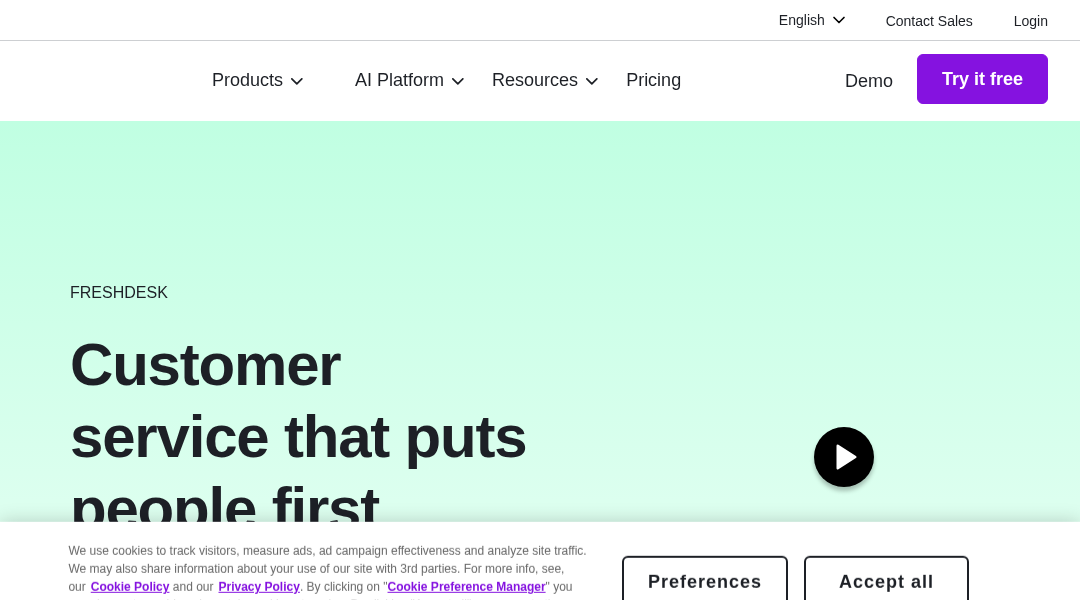
Freshdesk
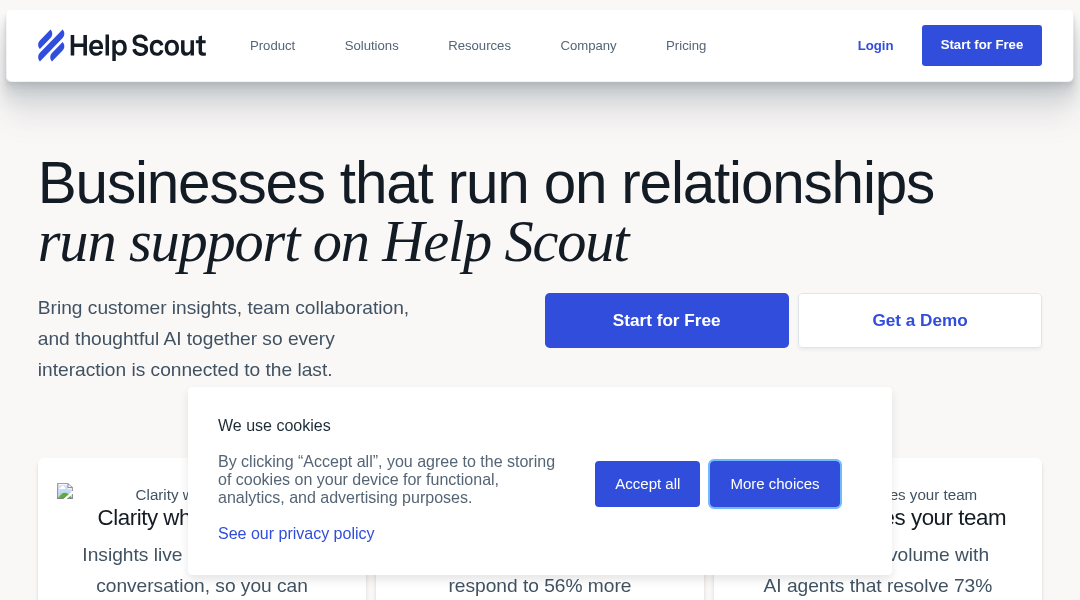
Help Scout
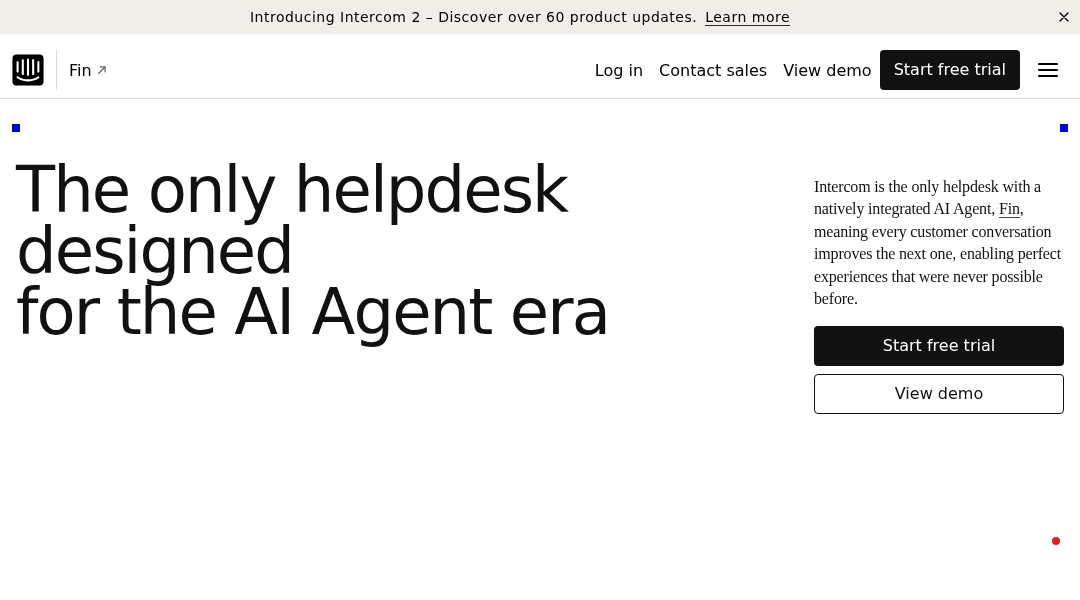
Intercom
Frequently Asked Questions
Which of Freshdesk, Help Scout, and Intercom has a free plan?
Only Help Scout has a permanent free plan, supporting up to 5 users, 1 inbox, and 1 Docs site. Freshdesk offers a time-limited 6-month free program capped at 2 agents, and Intercom has no free tier.
How does Intercom's Fin AI Agent pricing work?
Fin is billed at $0.99 per successful resolution regardless of how many messages that resolution took, and it can also be deployed standalone on top of an existing helpdesk without requiring additional seat licenses.
Which is the cheapest to start with?
Freshdesk's Growth plan starts at $19 per agent per month, below Help Scout's Standard plan at $25 per user per month and Intercom's Essential plan at $29 per seat per month billed annually.
Which tool is best for a team that wants AI to handle most routine tickets automatically?
Intercom is the most AI-first of the three, built around Fin as an autonomous resolution agent rather than treating AI as an add-on feature layered onto a traditional ticketing system.
Does any of these three include field service management for dispatching on-site technicians?
Only Freshdesk includes field service management alongside standard ticketing; neither Help Scout nor Intercom offers this.
Which is simplest for a small team just getting started?
Help Scout is generally the simplest and lowest-cost starting point, with a free plan and an email-inbox-style interface, compared to Intercom's more complex, AI-usage-based pricing and Freshdesk's broader but more ticket-centric feature set.
Related Comparisons
Read the full Freshdesk review · Read the full Help Scout review · Read the full Intercom review